

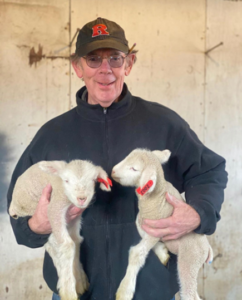
When were you diagnosed with Parkinson’s Disease? When did you start coming to 110 Fitness?Initially I was diagnosed as having essential tremors in 2022 while living in New Jersey, and was accordingly given medication for that. There was some positive response to that medication initially, but gradually the tremors returned and became worse. Ultimately, I made an appointment with Dr. Aissa Alexeeva, a Neurologist who made the call that I had PD as soon as she saw me walk in. She put me on the Carba DOPA / Levo DOPA regimen, and made the definitive diagnosis as PD in May, 2023. She described the importance of vigorous physical activity in slowing the progression of PD, and suggested that I join a Rock Steady Boxing program. We were still living in New Jersey at that time, and found a small Rock Steady Boxing group in Lawrence Township, NJ, relatively close to our home. Small meant that if there were more than 6 boxers at one time, that was a crowd, but there often were only two of us in a session. Still, it got me into the gym three days a week with the required rigorous activity, and I faithfully attended. While this was going on, we were making plans for moving to the Boston area of Massachusetts to be closer to our daughter Alexandria, who had graduated from Emmanuel College and was planning on remaining near Boston. We all fell in love with Hull, MA, as the place we wanted to move to, and found four different gyms hosting Rock Steady Boxing programs and located relatively close to Hull. By far the Rockland program was the strongest. We purchased a condo in Hull, and were living back and forth between NJ and MA for several months, gradually getting our house ready for sale and making the move to MA. During that time I kept up the visits to 110 Fitness when possible. Our house finally sold on June ninth of 2025, and we made the final move to MA at that time. This is also the time when I began attending classes regularly at 110 Fitness.
When did you start volunteering at 110 Fitness? What class(es) do you volunteer for? What inspired you to become a 110 Fitness volunteer? What is your favorite part about volunteering?My first foray as a volunteer was to attend the Corner orientation session in January, 2026. My first chance to use that information was the very next class period, Rock Steady Boxing 3/4 , and I have been volunteering for both Tuesday and Thursday sessions of that class since then. As far as what inspiration led me to volunteer, that harkens back to my involvement in many other organizations throughout my life. I’ve found that the more you give to an organization, the more invested you are with a program, the more that program becomes a part of your life, to the point that you begin to become a member of an extended family with a common goal. I saw that in the volunteers who served as Corners, and helped me to learn the drills of the boxing classes. As far as my favorite part of volunteering, that would be working with and getting to know the folks taking the Boxing 3/4 class, people who I probably wouldn’t have had the opportunity to meet otherwise.
What’s your favorite class or activity at 110 Fitness?My favorite class is the Thursday Rock Steady Boxing class, waiting for the whistle to blow while working the heavy bags. Then when the whistle blows, sprinting down the back of the gym as fast as you can go.
What do (did) you do for work? OR What do you do with your free time when you’re not at 110?I was a tenured Professor in the Department of Animal Science in the School of Environmental and Biological Sciences (SEBS) at Rutgers University, from July 1st, 1986, until January 1st, 2024, when I retired. Faculty in my Department conducted research work with domestic animals of all kinds (livestock, companion animals, and laboratory animals), primarily in the areas of nutrition, physiology, reproduction and behavior. The job description for the position I was hired into required that the applicant have a strong background in the Animal Sciences, but also be adept with the new fields (at that time) of Biotechnology and Molecular Genetics, a rarity in those days, but which reflected precisely my background and training. It was as if the author of the job description was looking at my CV while writing the job description, and subsequently I was offered the position and set about establishing my research lab.
Relatively few students in our major have experience with livestock or lab animals, but all of them have had some exposure to companion animals which often leads to a desire to work in some manner in an animal-related area. That desire to work professionally with animals leads them to consider the DVM degree as the only way to go. Most of our students enter Rutgers with the thought of ultimately attending veterinary school, but after experiencing the work environment of a veterinarian through our Coop Ed program, or the required Organic Chemistry courses, many of them choose to find gainful employment in other animal-related industries. I showed them that not having a DVM degree was not the end of the world, and that there were numerous examples of other animal-related employment career paths that they could pursue. My background allowed me to give them first-hand examples of some of those opportunities.
Scholarly Activity/Research
A faculty member in a research university such as Rutgers seeking promotion and tenure is evaluated on three broad categories: Scholarly Activity/Research, Teaching & Advising, and Service. My productivity in obtaining grant funding and publishing research papers stemmed from the establishment of a successful research program exploring the factors responsible for post-natal development of the rumen, one of the stomach compartments of a ruminant (e.g. cattle, sheep), and the primary site of a microbial fermentation that allows ruminants to utilize high fiber feeds as nutrient sources. Control-click on the “Into the Abyss” icon at the end of this document for a brief demonstration of retrieving rumen fluid from a fistulated dairy cow. My lab isolated, cloned and sequenced several genes that were highly expressed in mature rumen epithelium, but were expressed at very low levels, if at all, in the immature rumen epithelium of young lambs, our model organism for these studies. Subsequently we identified the regulatory elements on these genes that were responsible for this differential expression, which will allow future researchers to target dietary factors that will enhance rumen epithelial development. Several students, both graduate and undergraduate, participated in this research, and were listed as co-authors on the published scientific papers. My research results were well received, and resulted in invitations to present my research results at domestic and overseas scientific meetings. Whie not usually presented in this manner, scientific research is above all else FUN to do. Not to say that there aren’t periods of drudgery, but that pales in comparison to the excitement you experience when your data supports the hypotheses you are testing. And even then the search for that “something” that you may have missed when formulating your original hypotheses produces its own excitement.
Teaching & Advising
Much of the material in a course can seem dull and boring, and you need to be enthusiastic and engaging when presenting it to keep the students’ attention. I’ve taken a two-pronged approach to this. “Humorous anecdotes” play a big part in my lectures, especially if the students have directly experienced a situation similar to the example you bring up. While I dislike the description of an instructor as an entertainer, that in some ways is what you are when in front of a large lecture hall full of students. In tandem with that is the challenge of dealing with large amounts of information that need to be memorized. All disciplines have basic knowledge elements that students are required to memorize. You need to go beyond that, and present practical situations in which that memorized material is used in a logical manner to analyze and solve a problem. In this way the students get both the theoretical and the practical sides of a topic, and should thereby obtain a clearer picture of that topic.
One question always arises about college-level courses – how to keep the course material current. As a working scientist as well as an instructor, all the pieces needed are present. To be a successful scientist, you need to be aware of the developments in your field, as well as in related fields. That knowledge allows the researcher-instructor to know what topics need to be updated, added or removed from the current course material. In general it is not necessary to revise an entire course every year.. The main focus is on topics where major changes are occurring.
Because of my background, I became something of a “utility teacher” in my department, able to teach courses spanning the entire range of Animal Science courses. In my last 10 years at Rutgers my teaching assignments were
Fall Semester Spring Semester
Intro to Animal Science 11:067:142, 3 cr Animal Genetics 11:067:328, 3 cr
Livestock Judging 11:067:260, 4 cr Animal Microtechniques and Cell Culture 11:067:430, 4 cr
Animal Nutrition 11:067:330, 3 cr
Animal Nutrition Lab 11:067: 331, 1 cr
In addition to teaching classes, college faculty members also advise students on a range of topics. The primary advisor topic is Academic Advising, which is fairly straight, as the specific course sequence for any given major is well known. But if for some reason a student falls out of a course sequence, it can be difficult for them to catch up. This is where academic advising comes into play. As Mr. Spock once said to Chief Engineer Scott, “There are always alternatives!” We have the knowledge and experience to formulate an alternate pathway to get a student back on track.
My typical load of advisees was 25 incoming first- year students, plus around 75 continuing upperclass students. Many students never take the time to get to know their advisor, which is a tremendous loss for them. If a student puts in the effort to get to know their advisor, that advisor is better equipped to write a good letter of recommendation for that student for post-graduate studies or employment. Another aspect of that is the role of the advisor in career counseling, pointing a student in the right direction when they may be floundering as to what to do for their future, as noted above. For example, students who want to go to vet school can be singularly obstinate about their future. While I try to never crush their dreams for the future, I do give them a reality check. If they don’t have a decent GPA, their likelihood of being admitted to a good state-side school is low. The advisors can point students in the right directions for those willing to look for alternatives. If they can’t imagine themselves not attending vet school, they can try applying to an overseas school. In any case veterinarians graduate with a massive debt load, comparable to that of a freshly minted human MD, but without the earning potential that the human MD can expect in the future, and they need to be aware of the economic costs they will bear as a result. Often I would sponsor a student in our Coop Ed program, to enable the student to get on the job experience in a career that interests them. I have written hundreds, probably thousands, of letters of recommendation for students, and always sought to personalize that letter for the student’s background, the position the student was applying to, and their long-term goals.
Co-curricular advising deals with student involvement in activities outside of the classroom, but still related to their major. Student clubs are a prime example of these activities. Involvement with a student club allows students to acquire leadership skills and team work, as well as gaining additional experience related to their major. I was the long-time advisor to two student clubs, the Animal Science Club and the Seeing Eye Puppy Raising Club. The Animal Science Club had two major activities during the academic year, the North East Regional Animal Science Competition, and the Ag Field Day/Rutgers Day BBQ fundraiser to support travel to the competition. I worked with the competitors throughout the year to prepare the students for the competition (paper presentations, livestock judging, and quiz bowl), and organized the BBQ fund raiser. Nearly everyone in the Department (Faculty, Staff and Graduate students) participated in this activity. The Club had three 6-foot charcoal grills for cooking hamburgers, buffalo burgers, Italian sausages (sweet and hot), pork roll, hot dogs and veggie burgers, and were nonstop busy from 8:00 AM until 5:00 PM, serving upwards of 1,500 customers. The Seeing Eye Puppy Raising Club worked closely with The Seeing Eye, raising candidate puppies from weaning to 12 to 15 months of age, when they were returned to The Seeing Eye for evaluation for their potential to assist visually-impaired people. Students came to me and asked me to be the first club advisor and to help them establish the Seeing Eye Puppy Raising Club. We drafted and ratified a club constitution, worked with the University Housing Office to set up 12 student apartments to house the puppies (one puppy per apartment), and worked with the Department of Animal Science to construct a Bark Yard dog run for the puppies.
My effectiveness as a teacher and advisor is demonstrated by the numerous awards I have received for my teaching and advising, from both faculty and students, although the awards from the students are perhaps the most meaningful and heart-felt (e.g. Teacher of the Year from the Alpha Zeta Honor Society; the invitation to be the Baccalaureate speaker for the Class of 1997).
I am very proud of my students, undergraduate and graduate, and the contributions they’ve made to their chosen professional fields.
Service
My service activity included serving on multiple committees at the Departmental, School and University level at Rutgers, as well as on various State and Federal committees. At various times I was also the Acting Undergraduate Program Director for the Animal Science, Biotechnology, and Agriculture & Food Systems majors at Rutgers. With my broad knowledge of academic programs at Rutgers, I was appointed to the position of Associate Dean for Academic Administration at SEBS. My responsibilities included review and approval of all new and revised courses and curricula, establishing articulations with New Jersey Community Colleges and high schools for course credit transfers to Rutgers, and allocating resources for Graduate Teaching Assistants and Part-Time Lecturers, among other duties. After 10 years as an administrater, I returned to my first loves of teaching and advising as a faculty member.
One characteristic of the life of a professor is the variety of activities that they may encounter in a day’s work. For example, I could be in my barn clothes teaching students about the ruminant digestive system in the morning, and in the afternoon have changed to a coat and tie for a meeting with the Executive Dean on the financial shape of the School. Never a dull moment!
What would you like us to know about you and your family?
First of all, I was the oldest of eight siblings, and grew up on a small dairy farm in central Illinois. That certainly taught me early about responsibility and getting the job done – there was no autopilot to milk the cows! None of my relatives had attended college, although both of my parents wanted to go to college, but were unable to do so due to pressure from their parents. So from an early age it was a given that I would go to college, and would be the first member of my family to do so, and also led to the standing family joke that as the first to attend college, I didn’t know when to stop!Linda and I have been married for nearly 38 years. She was a Territory Sales Manager for Life Technologies, a Biotech firm that provided among other things ultrapure reagents, DNA modifying enzymes and cell culture media and supplements, to academic and pharmaceutical researchers. One day in June, 1987, she walked into my lab and tried to sell me stuff. After a couple of other sales stops to my lab, we had our first date in December, 1997, and married in August, 1998. Yes, love among the Bunsen burners! I have a 44 year old daughter from a previous marriage, who is a Registered Nurse in Illinois and has a 12-year old son. Linda and I have a 27-year old daughter who is the manager of Graphics and Marketing for a small law firm here in Massachussets.
Any fun hobbies you’d like to share?
There are two hobbies that figured into my retirement plans, model railroading and model ship building. While there is a large amount of “macro” handwork, there is a lot of “micro” handwork which requires strong hand eye coordination. The onset of PD’s symptoms obviously puts something of a damper on these plans, and while I’m still planning on pursuing these hobbies, it is going to require some imagination to be successful. Joseph Dawley faced the same dilemma as a painter in the Realism camp when he was diagnosed with PD. He persisted and changed to become a successful Impressionist artist.
How has 110 Fitness impacted your life outside of the gym?
The people at 110 Fitness in many ways have become a family. Their presence gives me a feeling of support and confidence outside of the gym, knowing that if needed there are people with a common understanding of what it means to live with PD close by to help with any situation. Two folks from this extended family have become some of my best friends.Linda and I did have to cancel some of our travel plans early on, but as time has progressed and we’ve become more comfortable dealing with it, we are gradually re-expanding our travel goals. Not to where those travel plans were, but moving in that direction.